
Editorial
The Quality Ceiling of Games Is About to Rise
The Quality Ceiling of Games Is About to Rise
The Quality Ceiling of Games Is About to Rise
Julian Park
CEO

The following is an adaptation of “Test Every Idea, Build the Best One: Amplify Creative Exploration Without Developer Bottlenecks,” a talk presented by Bezi’s co-founder Julian Park at GDC 2026.
We believe the quality ceiling of games is about to rise. The reason has nothing to do with better engines or bigger budgets. More ideas are going to survive long enough to prove themselves - the weird ones, the ambitious ones, the ones that would have died in a backlog because nobody had time to build them.
This might sound optimistic given the current anxiety around AI-generated "slop." But the games that defined the last decade tell a consistent story. It has nothing to do with generation, but everything to do with experimentation.
The pattern behind the making of best games
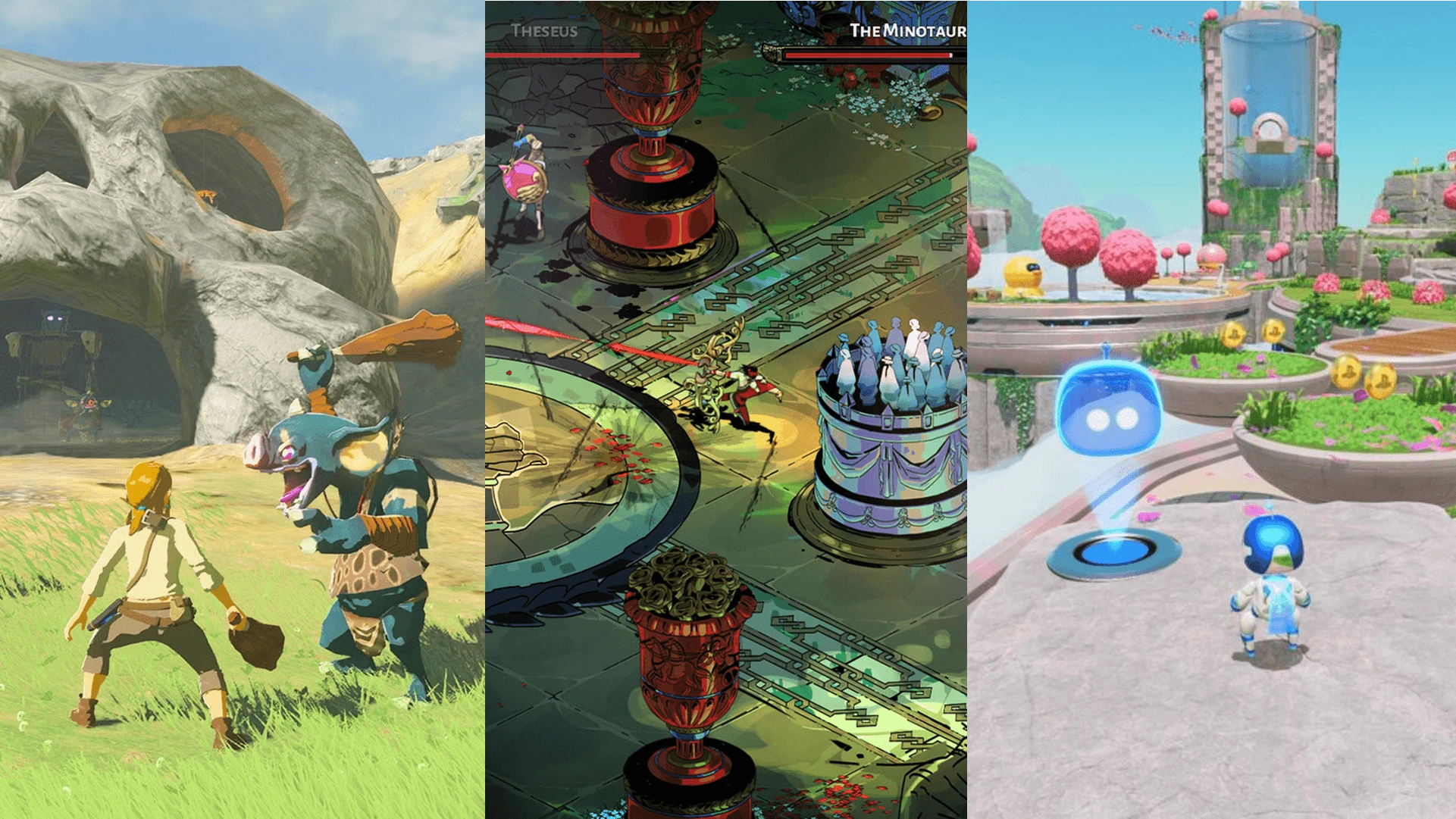
Think about Breath of the Wild. Nintendo built a 2D prototype in the style of the original NES Zelda just to test physics-based puzzle interactions before committing to the full 3D open world. Fujibayashi showed that prototype at GDC 2017. The game spent five years in development, and the team had resources to explore hundreds of ideas about how systems should interact.
Supergiant built Hades as an Early Access title specifically so they could iterate on mechanics with real players for two years before shipping. They reworked boons, weapons, and entire combat systems based on what they learned from each playable build.
Team Asobi spent a full third of Astro Bot's development on prototyping alone. Everyone on the team was encouraged to build ideas. They prototyped a sponge that squeezed dry using the adaptive trigger. It was fun, so it shipped. They prototyped a coffee grinder, a roulette wheel, a bird flight level. Most of it got cut. But the process of trying everything is what made the final game extraordinary.
These teams all had something most teams don't: the time and resources to run that many experiments.
Nintendo had five years and a massive internal team. Supergiant had a focused studio with no publisher deadline. Team Asobi had three and a half years and the backing of PlayStation Studios.
Most teams don't get to operate that way.
The real bottleneck was never ideas.
Everyone in game development has been in a meeting where someone pitches an idea and the first response is "do we have the bandwidth?"

That question kills ideas before anyone evaluates whether they're good. There wasn't time, or the sprint was already locked, or the person who would build it is deep in something else. The idea goes into a backlog, or a doc, or just disappears.
The prototyping loop on most teams looks like this: a designer has an idea, sketches it or writes it up, then someone greyboxes it in engine - cubes, capsules, placeholder assets, basic scripts. The team playtests. Notes come back. Another round happens. That cycle, from concept to playable greybox to feedback to next version, takes days or weeks depending on complexity and who's available.
The bottleneck is time and capacity. Designers who work in engine still don't have unlimited hours. Programmers want to experiment with implementation but need to leave room for polish and optimization. Producers are looking at a calendar that doesn't have space for three more rounds of iteration on something that might get scrapped.
So teams prototype fewer ideas. They commit earlier. They go with the first version that clears the bar instead of exploring whether something better exists.
There's a telling story from the creation of Crypt of the Necrodancer. Ryan Clark was trying to make a roguelike that felt fair, and he started experimenting with turn length. He kept making turns shorter, forcing the player to think faster. At some point, turns got short enough that it stopped feeling like turns and started feeling like moving on a beat. He tried playing it to "Thriller" and the whole thing clicked. That fluke became the entire identity of the game, but it only surfaced because Clark was playing a working prototype and noticing how it felt. On a tight schedule, that discovery never happens.
What changes when experimentation gets cheaper
Lost Arcade is a three-person team. Mark is the programmer, Blake handles design and production, and Brett is the artist. They're building Voodoo Fishing - a spooky multiplayer puppet fishing adventure set in a Louisiana swamp. Retro low-poly art (think PS1 and N64) with modern volumetric lighting, characters that look like something out of a darker Jim Henson project, and dead serious skill-based fishing mechanics with gesture controls for casting and reeling. A deeply weird, deeply specific game that only gets made when a small team has the freedom to follow their instincts.
Three people, one programmer. Every feature, every tool, every prototype has to flow through Mark. That's the constraint we just described, concentrated into the smallest possible team.
They started using Bezi, and the dynamic changed. Blake, who is not a programmer, could take an idea and build a working version of it in engine. The output wasn't production-ready code, but it was a playable prototype that was, in his words, "nine tenths of the way there." Mark's role shifted. Instead of spending half his time building Blake's ideas from scratch, he was spending maybe 10% reviewing and polishing something that already worked - and the rest on perfecting metasystems, building bespoke mechanics, and cruising through a long-awaited refactor.
The whole team could stand up a version of a feature by the end of an afternoon, play it, discuss it, and keep going.
But the story that really stands out is Brett's. Brett describes himself as an "art artist." He does not write code. But he started a simple script to duplicate fish prefabs, and Blake used Bezi to expand it into a full visual manager - a custom Unity Editor tool with a UI that lets the team organize, balance, and manage over 100 fish species and their ecosystems. Mark didn't write any of it. Because it was an editor tool and not core game code, he didn't even need to review it.
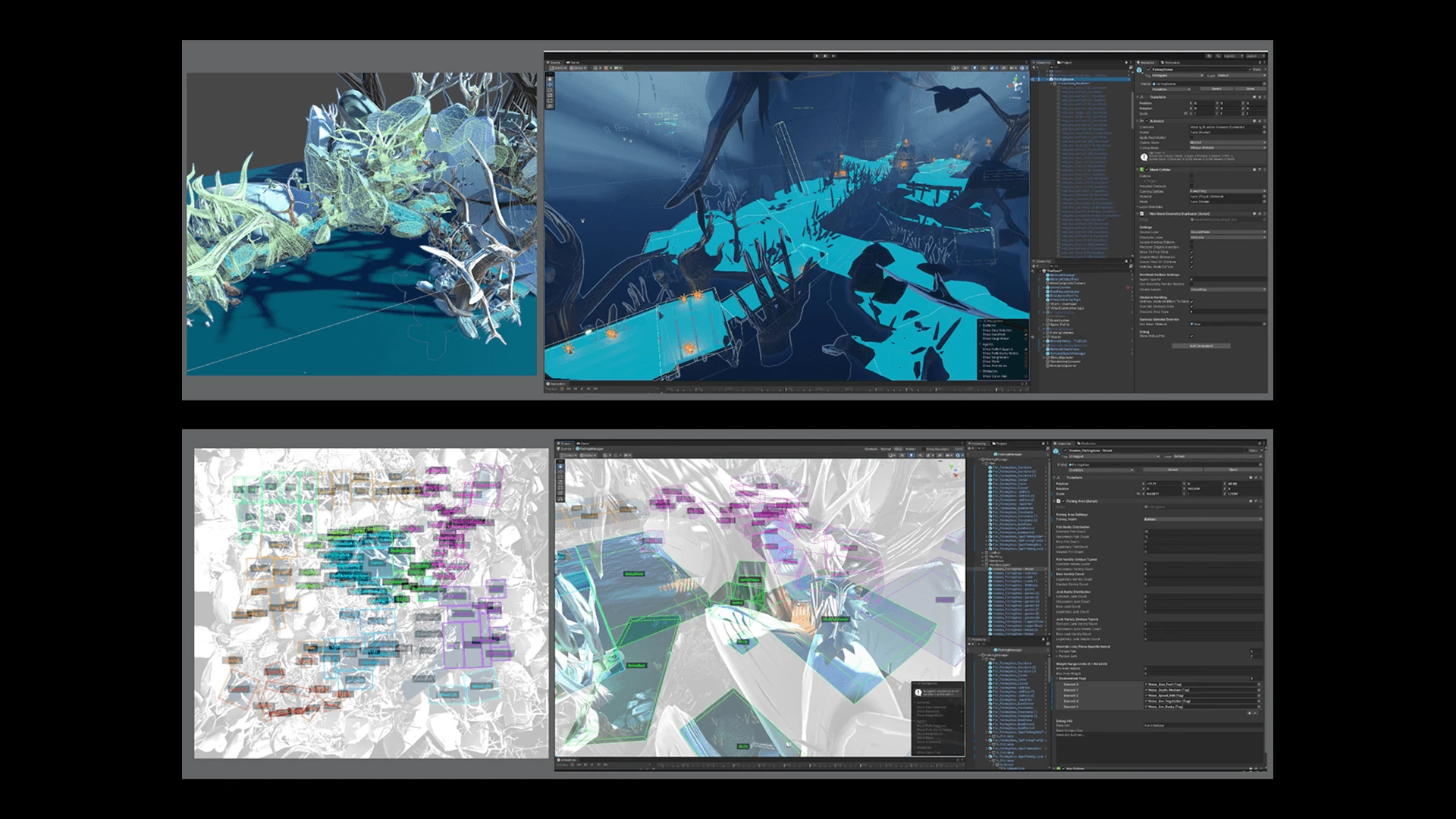
Brett also built a color-coded bounding box visualizer so he could identify specific fishing biomes directly in the engine. At a traditional studio, that tool requires pulling a programmer away from their work. Brett built it completely on his own.
An artist, building tools that improve his own workflow, without asking anyone for permission or waiting in a queue.
For context: Bezi is a development tool that integrates directly into the Unity Editor. It understands full project context - code, scenes, prefabs, assets - beyond just script files. It has an Agent Mode where it can directly manipulate the editor: creating GameObjects, configuring components, building tools, setting up prefabs. Every change is reviewable before you accept it, and everything is checkpointed so you can roll back with one click. The human stays in control.
That's what made this workflow possible. Blake and Brett could describe what they needed, and Bezi handled the technical execution so they could go from idea to testing without fighting an unfamiliar interface. Mark's time shifted from building everything from scratch to reviewing, refining, and focusing on the hard engineering problems.
What compounds over time: creative breakthroughs
When the cost of each prototype drops low enough, something compounds. You build faster, and you also learn faster. Every prototype teaches you something about your game. Every version you playtest gives you information you didn't have before. The more ideas you test, the better your judgment gets about which ones are worth pursuing. Speed saves time, and it also sharpens the creative instincts that determine where that time goes.
Breath of the Wild, Hades, Astro Bot. Those teams had the capacity to test enough ideas to find the extraordinary ones. That was their advantage - not better ideas at the outset, but more chances to discover which ideas were great.
When every team has that capacity, regardless of size or timeline, the best ideas win more often. And that's how you make better games.
The following is an adaptation of “Test Every Idea, Build the Best One: Amplify Creative Exploration Without Developer Bottlenecks,” a talk presented by Bezi’s co-founder Julian Park at GDC 2026.
We believe the quality ceiling of games is about to rise. The reason has nothing to do with better engines or bigger budgets. More ideas are going to survive long enough to prove themselves - the weird ones, the ambitious ones, the ones that would have died in a backlog because nobody had time to build them.
This might sound optimistic given the current anxiety around AI-generated "slop." But the games that defined the last decade tell a consistent story. It has nothing to do with generation, but everything to do with experimentation.
The pattern behind the making of best games
Think about Breath of the Wild. Nintendo built a 2D prototype in the style of the original NES Zelda just to test physics-based puzzle interactions before committing to the full 3D open world. Fujibayashi showed that prototype at GDC 2017. The game spent five years in development, and the team had resources to explore hundreds of ideas about how systems should interact.
Supergiant built Hades as an Early Access title specifically so they could iterate on mechanics with real players for two years before shipping. They reworked boons, weapons, and entire combat systems based on what they learned from each playable build.
Team Asobi spent a full third of Astro Bot's development on prototyping alone. Everyone on the team was encouraged to build ideas. They prototyped a sponge that squeezed dry using the adaptive trigger. It was fun, so it shipped. They prototyped a coffee grinder, a roulette wheel, a bird flight level. Most of it got cut. But the process of trying everything is what made the final game extraordinary.
These teams all had something most teams don't: the time and resources to run that many experiments.
Nintendo had five years and a massive internal team. Supergiant had a focused studio with no publisher deadline. Team Asobi had three and a half years and the backing of PlayStation Studios.
Most teams don't get to operate that way.
The real bottleneck was never ideas.
Everyone in game development has been in a meeting where someone pitches an idea and the first response is "do we have the bandwidth?"
That question kills ideas before anyone evaluates whether they're good. There wasn't time, or the sprint was already locked, or the person who would build it is deep in something else. The idea goes into a backlog, or a doc, or just disappears.
The prototyping loop on most teams looks like this: a designer has an idea, sketches it or writes it up, then someone greyboxes it in engine - cubes, capsules, placeholder assets, basic scripts. The team playtests. Notes come back. Another round happens. That cycle, from concept to playable greybox to feedback to next version, takes days or weeks depending on complexity and who's available.
The bottleneck is time and capacity. Designers who work in engine still don't have unlimited hours. Programmers want to experiment with implementation but need to leave room for polish and optimization. Producers are looking at a calendar that doesn't have space for three more rounds of iteration on something that might get scrapped.
So teams prototype fewer ideas. They commit earlier. They go with the first version that clears the bar instead of exploring whether something better exists.
There's a telling story from the creation of Crypt of the Necrodancer. Ryan Clark was trying to make a roguelike that felt fair, and he started experimenting with turn length. He kept making turns shorter, forcing the player to think faster. At some point, turns got short enough that it stopped feeling like turns and started feeling like moving on a beat. He tried playing it to "Thriller" and the whole thing clicked. That fluke became the entire identity of the game, but it only surfaced because Clark was playing a working prototype and noticing how it felt. On a tight schedule, that discovery never happens.
What changes when experimentation gets cheaper
Lost Arcade is a three-person team. Mark is the programmer, Blake handles design and production, and Brett is the artist. They're building Voodoo Fishing - a spooky multiplayer puppet fishing adventure set in a Louisiana swamp. Retro low-poly art (think PS1 and N64) with modern volumetric lighting, characters that look like something out of a darker Jim Henson project, and dead serious skill-based fishing mechanics with gesture controls for casting and reeling. A deeply weird, deeply specific game that only gets made when a small team has the freedom to follow their instincts.
Three people, one programmer. Every feature, every tool, every prototype has to flow through Mark. That's the constraint we just described, concentrated into the smallest possible team.
They started using Bezi, and the dynamic changed. Blake, who is not a programmer, could take an idea and build a working version of it in engine. The output wasn't production-ready code, but it was a playable prototype that was, in his words, "nine tenths of the way there." Mark's role shifted. Instead of spending half his time building Blake's ideas from scratch, he was spending maybe 10% reviewing and polishing something that already worked - and the rest on perfecting metasystems, building bespoke mechanics, and cruising through a long-awaited refactor.
The whole team could stand up a version of a feature by the end of an afternoon, play it, discuss it, and keep going.
But the story that really stands out is Brett's. Brett describes himself as an "art artist." He does not write code. But he started a simple script to duplicate fish prefabs, and Blake used Bezi to expand it into a full visual manager - a custom Unity Editor tool with a UI that lets the team organize, balance, and manage over 100 fish species and their ecosystems. Mark didn't write any of it. Because it was an editor tool and not core game code, he didn't even need to review it.
Brett also built a color-coded bounding box visualizer so he could identify specific fishing biomes directly in the engine. At a traditional studio, that tool requires pulling a programmer away from their work. Brett built it completely on his own.
An artist, building tools that improve his own workflow, without asking anyone for permission or waiting in a queue.
For context: Bezi is a development tool that integrates directly into the Unity Editor. It understands full project context - code, scenes, prefabs, assets - beyond just script files. It has an Agent Mode where it can directly manipulate the editor: creating GameObjects, configuring components, building tools, setting up prefabs. Every change is reviewable before you accept it, and everything is checkpointed so you can roll back with one click. The human stays in control.
That's what made this workflow possible. Blake and Brett could describe what they needed, and Bezi handled the technical execution so they could go from idea to testing without fighting an unfamiliar interface. Mark's time shifted from building everything from scratch to reviewing, refining, and focusing on the hard engineering problems.
What compounds over time: creative breakthroughs
When the cost of each prototype drops low enough, something compounds. You build faster, and you also learn faster. Every prototype teaches you something about your game. Every version you playtest gives you information you didn't have before. The more ideas you test, the better your judgment gets about which ones are worth pursuing. Speed saves time, and it also sharpens the creative instincts that determine where that time goes.
Breath of the Wild, Hades, Astro Bot. Those teams had the capacity to test enough ideas to find the extraordinary ones. That was their advantage - not better ideas at the outset, but more chances to discover which ideas were great.
When every team has that capacity, regardless of size or timeline, the best ideas win more often. And that's how you make better games.
Haikus by Bezi
Up goes the ceiling!
With the power to create
Gotta make 'em all.
Join thousands of developers, artists, and designers using Bezi to build their games


Send yourself a link and continue on your computer.
USED ONLY FOR YOUR DOWNLOAD LINK.