
Editorial
How Lost Arcade 2X'd Its Engineering Output and Slashed Tool Dev Time by 95%
How Lost Arcade 2X'd Its Engineering Output and Slashed Tool Dev Time by 95%
How Lost Arcade 2X'd Its Engineering Output and Slashed Tool Dev Time by 95%
Julian Park
CEO
Overview
The Situation: Lost Arcade, a small indie studio, hit a major bottleneck while developing their debut title, Voodoo Fishin'.
The Problem: With only one programmer swamped by building core gameplay, the two artists could not get custom tools or automation and were stuck with slow, manual workflows that dragged creative iteration and constantly delayed progress.
The Solution: Using Bezi, Lost Arcade empowered their technical artist to rapidly build and deploy custom Unity tools without writing a single line of C#, facilitating complex processes like NavMesh generation and ScriptableObject organization with in-editor interfaces.
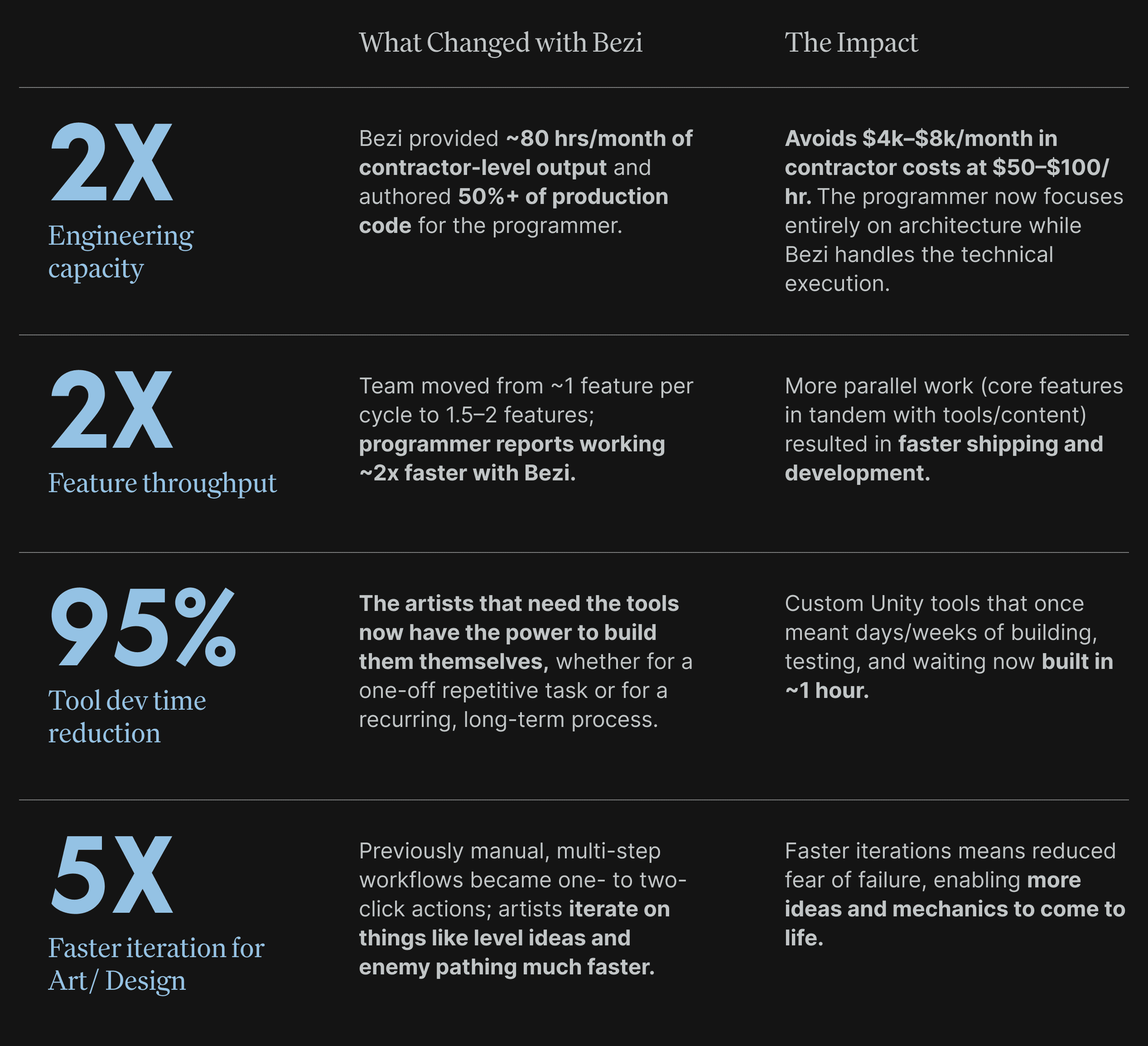
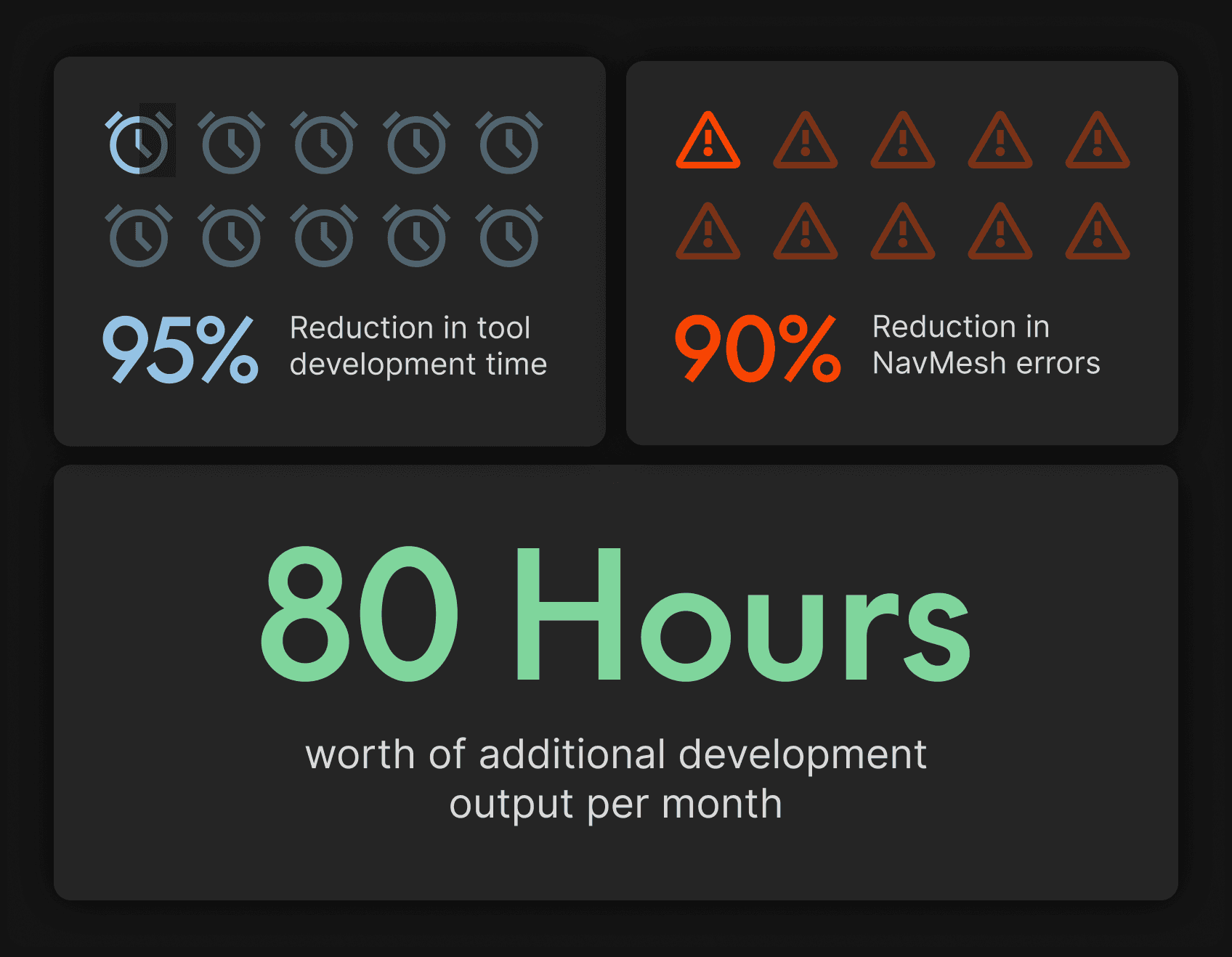
The Impact: This shift effectively doubled the team's engineering capacity, freeing up an estimated 80 hours of programmer time per month (20 hours a week) and accelerating their overall feature velocity by up to 2x, giving them the kind of competitive edge typically reserved for much larger studios with dedicated tool development teams.
To learn more about how studios are using Bezi, please reach out to hello@bezi.com.
Results Summary
About Lost Arcade
Lost Arcade was founded by three seasoned developers: Mark, the programmer; Blake the technical artist; and Brett, the artist and modeler. After nearly 20 years of making games for other companies, they took the leap to form their own studio, driven by a core philosophy of creative independence. Their mission is to build games they are passionate about, without the compromises that often come with external publishers. This commitment to self-publishing means that every decision, from game design to production workflow, is all about quality and maintaining a strong creative vision.
Their debut project, Voodoo Fishin', is a title that blends a Jim Henson-inspired low-poly aesthetic with a co-op horror fishing adventure. The team's goal is not to chase blockbuster sales but to build a dedicated community of players who resonate with their unique world. This passion-driven approach puts immense pressure on their small team to deliver a high-quality, polished experience.
Check out Voodoo Fishin' on Steam to add it to your wishlist before their release!
The Problem
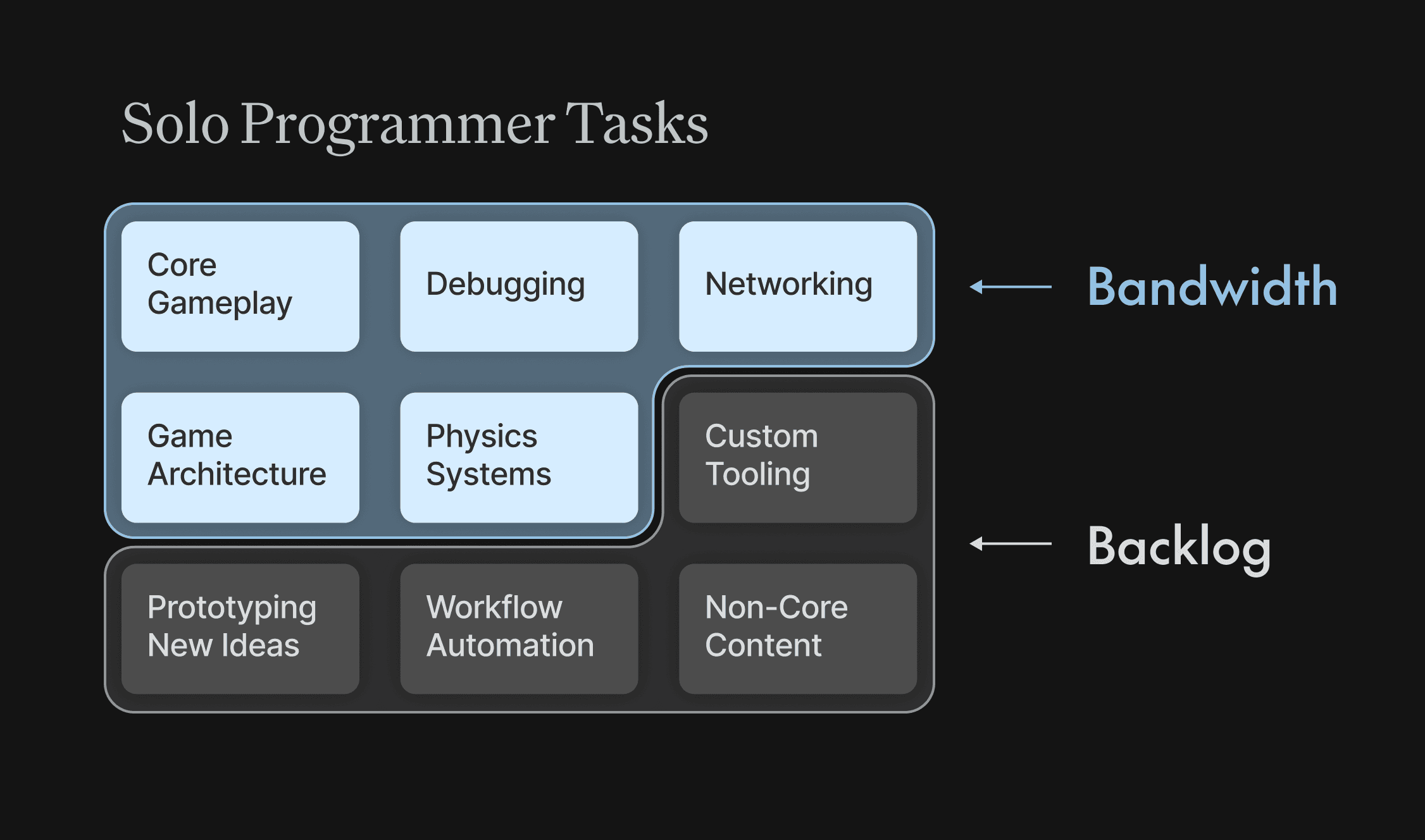
With Mark as the sole programmer, he was constantly pulled in different directions, juggling high-value, complex engineering problems (core gameplay mechanics and physics systems) with a queue of smaller support tasks and tool requests from the team. This programmer bottleneck became a direct cap on the game's quality and the team's creative freedom.
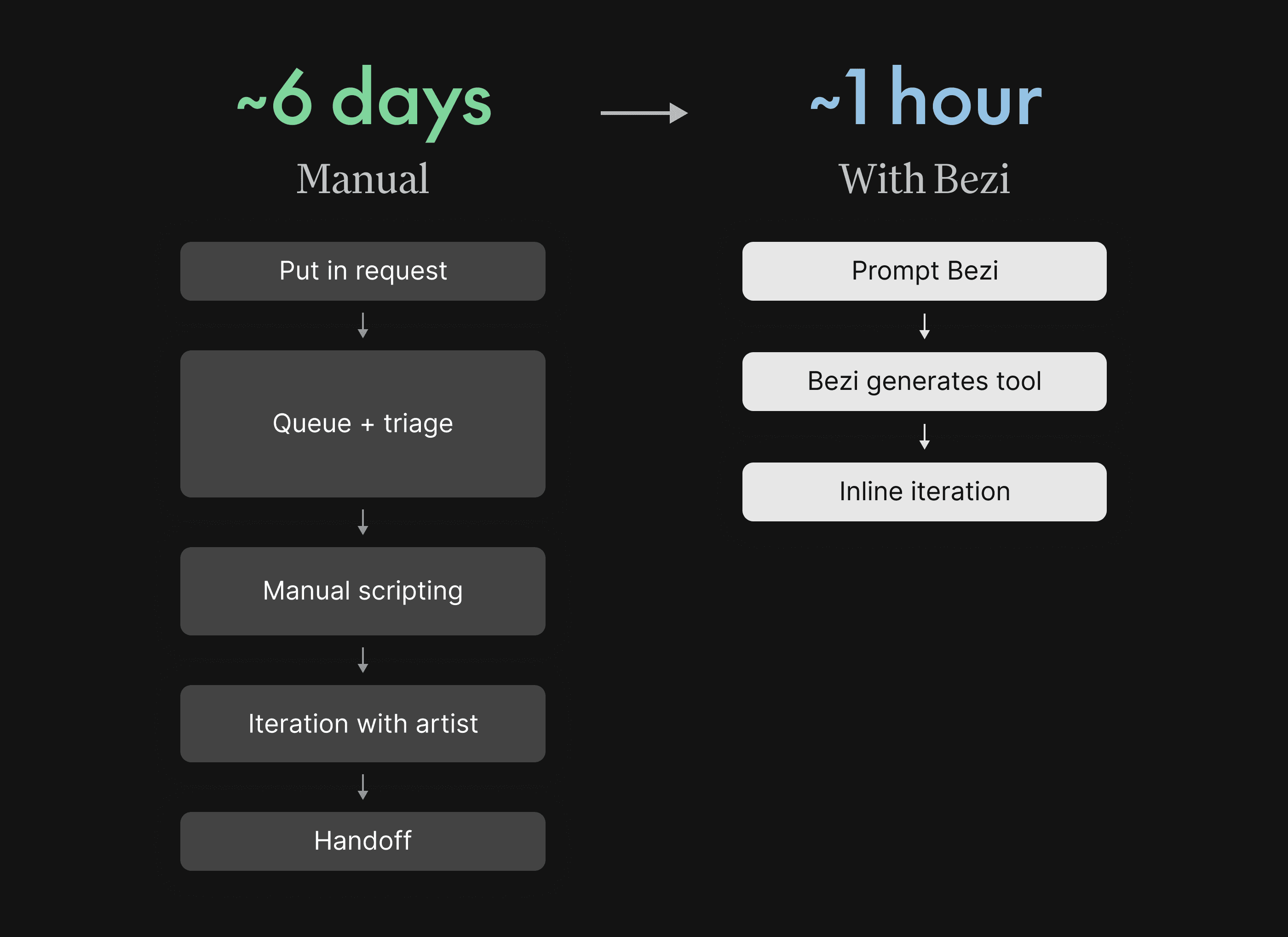
For Blake and Brett, every potential workflow improvement, from a small quality-of-life tweak to a major time-saving tool, was an impossibility: otherwise, it would take Mark's time from critical gameplay features. However, this meant tasks like NavMesh creation that, with a tool, could be done in five minutes instead took an hour or more.
This single issue was representative of a larger problem the studio faced: they were accumulating massive "workflow debt." Dozens of these small, manual processes were piling up, costing the art team an estimated 20-30% of their week. This dynamic created a subtle but powerful drag on the entire creative process, as Blake and Brett would hesitate to experiment or suggest workflow improvements, knowing that each request just added to Mark's already overwhelming workload.
The team was effectively forced to operate at a fraction of its true capacity and had to choose between committing more financial resources into hiring an external developer, or scope down the game for their upcoming launch.
The Solution
Lost Arcade's adoption of Bezi marked a turning point in their development. They used Bezi to address the root cause of their challenges and enabled Blake and Brett to unblock themselves, by independently creating custom tools and new feature prototypes.
Everything changed after an unexpected interaction with Bezi.
Blake, the technical artist, was trying to make a series of edits to some UI prefabs. He described his problem to Bezi, expecting it to provide a script or a series of steps. Instead, Bezi proactively built a custom Editor tool to perform this (and future similar) tasks for him.
"I stumbled across [Bezi's tooling ability] by accident when we were making the 'FishCaughtUI'. It refactored it with a click of a tool. I was like, holy shit. That was really quick."
- Blake, Technical Artist
This was, as Blake described it, when the dots connected. The team realized that Bezi understood the principles of efficient game development workflows and could be used for more powerful, foundational, and scalable work than simple coding tasks.
This discovery unlocked a new realm of possibility for Lost Arcade. Bezi allowed Blake to bypass his existing coding limitations, empowering him to create the custom tools he envisioned. He quickly built an arsenal of functional, robust tooling that addressed the art team's needs without interrupting Mark’s work on game-critical features.
He accomplished this almost entirely through Bezi, without ever needing to open an IDE. The process was collaborative and iterative; after Blake described a problem and the ideal outcome, Bezi would propose a solution and provide the scripts and steps to test it out. He could then try the results and refine the functionality through natural language feedback.
He described this workflow as a "risk free sandbox to test solutions, see what's possible, and 'pick a programmer's brain', without any wasted effort or time sink". He applied Bezi as a personal mentor and senior-level collaborator for custom tool development, empowering him to serve as a “one-man” tooling team, a luxury typically afforded only to large AAA studios.
"With Bezi, I could finally build the exact tools we needed myself. What used to be a week-long request to our programmer, I can now prototype and ship in an afternoon."
- Blake, Technical Artist
With this, Blake rapidly developed a suite of custom tools that directly addressed the team's most pressing workflow pains. Two of the many examples include:
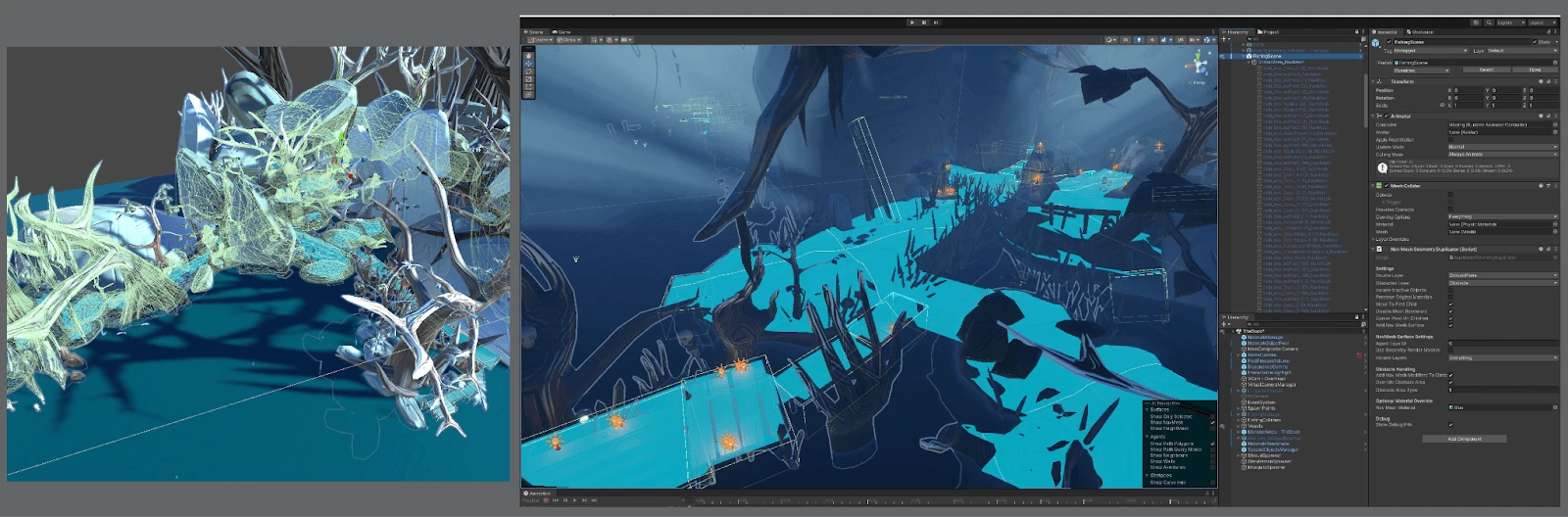
The NavMeshGenerator: This tool was built to create NavMeshes for the game's enemies. The tool automates the process of duplicating collision objects, organizing them into a consistent structure, adjusting the models for optimal surface/path fit, and cutting holes for obstacles.
This process would usually take the artist in-and-out of Unity, require trial-and-error, and lead to a potentially messier, hacky result.
In addition to the pared-down time it took to create, this tool also saved them the hours that would've otherwise been spent reproducing the results manually. A reusable tool meant consistent, quality results, making future updates "worry-free" for anyone on the team.
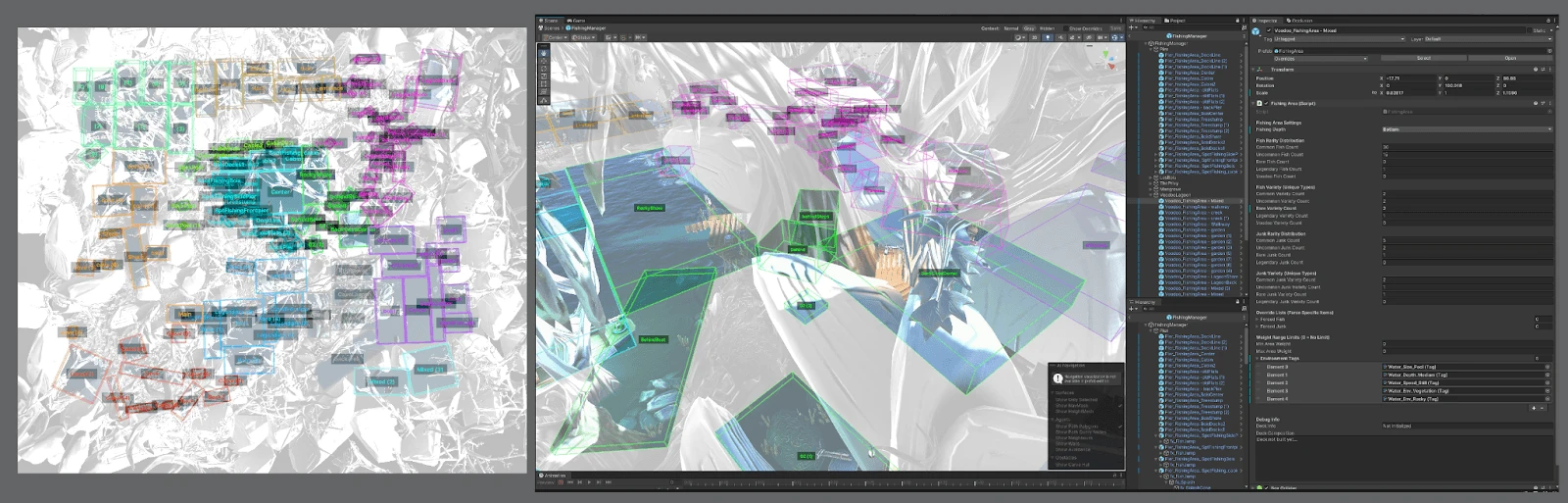
The FishingManagerDisplay: A simple editor script that identifies all fishing area objects, visualizes their bounds, and labels them for easy adjustment, organization, and identification.
Addressing the scalability issue of managing over 100 fishing zones, this tool provides a crucial quality-of-life improvement.
This turned a "clunky process" of cross-referencing spreadsheets and hunting for objects in the hierarchy into an intuitive, visual workflow. It allowed artists to spend less time on tedious management and more time actually making the art for the game.
The Impact
The result was a dramatic acceleration across Lost Arcade’s entire production pipeline. The team now ships features and resolves tickets 1.5 to 2 times faster than before, without sacrificing quality or adding headcount.
This production-wide efficiency was driven by two fundamental changes to the team’s workflow that Bezi was able to unlock for the team:
Artists could now build their own tools to accomplish technical tasks that previously blocked them, allowing them to experiment freely without adding to the programmer’s backlog.
In turn, with artists managing these technical needs themselves, the lead programmer was freed from “small tasks” to focus on critical work like architecture and networking.
The artists and designers unblock their own workflow.
No longer blocked by engineering dependencies, the artists can experiment with new ideas freely. They used Bezi to quickly build and modify their own tools in real-time, turning multi-hour manual tasks into single-click actions.
"The ability to create new tools is a game changer. My workflow is so much faster, and I can experiment with new ideas without having to wait. It just feels more creative."
- Brett, Artist & Modeler
Each of the tools Brett and Blake were able to make with Bezi took less than an hour to build, but saved them countless hours throughout production.
The NavMeshGenerator tool reduced a tedious process to just "2 clicks", saving an estimated 15 hours on enemy creation alone and allowing for at least 5x faster iteration on level design and pathing.
The FishingManagerDisplay saved about 10 minutes per day, which added up to over 40 hours in the final year of development. More importantly, it replaced a frustrating, mentally taxing workflow, freeing up the artists' energy for purely creative work.
These examples are snapshots of the toolkit that Lost Arcade built over the last few months. The positive effects compound across the dozens of tools in use, saving Blake and Brett time, frustration, and experimentation-anxiety — without sacrificing the developer's sanity.
Since artists can manage smaller technical requests themselves and meet the quality bar, Mark, the lead programmer, was free to focus on high-impact work like architecture and networking.
The custom tool’s built-in logic and validation dramatically reduces the potential for human error. The NavMeshGenerator was prized for its ability to produce a "consistent result" every time, resulting in a ~90% reduction in NavMesh configuration errors. This means that Mark isn't just spared the time it would take to build them in the first place; it also eliminates countless hours of downstream debugging and troubleshooting.
This situation is compounded across the entire game, effectively removing the production pipeline’s primary bottleneck. Now that artists are free to do most small design and support tasks and their output is more consistent, Mark’s bandwidth and output is nearly double what it was before.
“It’s as if someone cloned me or made me twice as fast. I have at least 20% more time to program each week.”
-Mark, Lead Programmer
This reclaimed time is spent on the high-value engineering tasks that directly improve the quality and scope of the game, primarily the game’s architecture. Features that were originally deemed out of scope, such as full networking for co-op play and complex physics systems for the fishing mechanics, are now not just possible, but almost done.
The team's own assessment is that using Bezi has resulted in the same output as hiring another senior programmer, contracted to work 80 hours a month.
As a small indie studio, they no longer have to choose between spending their finite budget on another developer or drastically cutting their game’s scope for launch. They could actually build the game they wanted, with no compromises.
Overview
The Situation: Lost Arcade, a small indie studio, hit a major bottleneck while developing their debut title, Voodoo Fishin'.
The Problem: With only one programmer swamped by building core gameplay, the two artists could not get custom tools or automation and were stuck with slow, manual workflows that dragged creative iteration and constantly delayed progress.
The Solution: Using Bezi, Lost Arcade empowered their technical artist to rapidly build and deploy custom Unity tools without writing a single line of C#, facilitating complex processes like NavMesh generation and ScriptableObject organization with in-editor interfaces.
The Impact: This shift effectively doubled the team's engineering capacity, freeing up an estimated 80 hours of programmer time per month (20 hours a week) and accelerating their overall feature velocity by up to 2x, giving them the kind of competitive edge typically reserved for much larger studios with dedicated tool development teams.
To learn more about how studios are using Bezi, please reach out to hello@bezi.com.
Results Summary
About Lost Arcade
Lost Arcade was founded by three seasoned developers: Mark, the programmer; Blake the technical artist; and Brett, the artist and modeler. After nearly 20 years of making games for other companies, they took the leap to form their own studio, driven by a core philosophy of creative independence. Their mission is to build games they are passionate about, without the compromises that often come with external publishers. This commitment to self-publishing means that every decision, from game design to production workflow, is all about quality and maintaining a strong creative vision.
Their debut project, Voodoo Fishin', is a title that blends a Jim Henson-inspired low-poly aesthetic with a co-op horror fishing adventure. The team's goal is not to chase blockbuster sales but to build a dedicated community of players who resonate with their unique world. This passion-driven approach puts immense pressure on their small team to deliver a high-quality, polished experience.
Check out Voodoo Fishin' on Steam to add it to your wishlist before their release!
The Problem
With Mark as the sole programmer, he was constantly pulled in different directions, juggling high-value, complex engineering problems (core gameplay mechanics and physics systems) with a queue of smaller support tasks and tool requests from the team. This programmer bottleneck became a direct cap on the game's quality and the team's creative freedom.
For Blake and Brett, every potential workflow improvement, from a small quality-of-life tweak to a major time-saving tool, was an impossibility: otherwise, it would take Mark's time from critical gameplay features. However, this meant tasks like NavMesh creation that, with a tool, could be done in five minutes instead took an hour or more.
This single issue was representative of a larger problem the studio faced: they were accumulating massive "workflow debt." Dozens of these small, manual processes were piling up, costing the art team an estimated 20-30% of their week. This dynamic created a subtle but powerful drag on the entire creative process, as Blake and Brett would hesitate to experiment or suggest workflow improvements, knowing that each request just added to Mark's already overwhelming workload.
The team was effectively forced to operate at a fraction of its true capacity and had to choose between committing more financial resources into hiring an external developer, or scope down the game for their upcoming launch.
The Solution
Lost Arcade's adoption of Bezi marked a turning point in their development. They used Bezi to address the root cause of their challenges and enabled Blake and Brett to unblock themselves, by independently creating custom tools and new feature prototypes.
Everything changed after an unexpected interaction with Bezi.
Blake, the technical artist, was trying to make a series of edits to some UI prefabs. He described his problem to Bezi, expecting it to provide a script or a series of steps. Instead, Bezi proactively built a custom Editor tool to perform this (and future similar) tasks for him.
"I stumbled across [Bezi's tooling ability] by accident when we were making the 'FishCaughtUI'. It refactored it with a click of a tool. I was like, holy shit. That was really quick."
- Blake, Technical Artist
This was, as Blake described it, when the dots connected. The team realized that Bezi understood the principles of efficient game development workflows and could be used for more powerful, foundational, and scalable work than simple coding tasks.
This discovery unlocked a new realm of possibility for Lost Arcade. Bezi allowed Blake to bypass his existing coding limitations, empowering him to create the custom tools he envisioned. He quickly built an arsenal of functional, robust tooling that addressed the art team's needs without interrupting Mark’s work on game-critical features.
He accomplished this almost entirely through Bezi, without ever needing to open an IDE. The process was collaborative and iterative; after Blake described a problem and the ideal outcome, Bezi would propose a solution and provide the scripts and steps to test it out. He could then try the results and refine the functionality through natural language feedback.
He described this workflow as a "risk free sandbox to test solutions, see what's possible, and 'pick a programmer's brain', without any wasted effort or time sink". He applied Bezi as a personal mentor and senior-level collaborator for custom tool development, empowering him to serve as a “one-man” tooling team, a luxury typically afforded only to large AAA studios.
"With Bezi, I could finally build the exact tools we needed myself. What used to be a week-long request to our programmer, I can now prototype and ship in an afternoon."
- Blake, Technical Artist
With this, Blake rapidly developed a suite of custom tools that directly addressed the team's most pressing workflow pains. Two of the many examples include:
The NavMeshGenerator: This tool was built to create NavMeshes for the game's enemies. The tool automates the process of duplicating collision objects, organizing them into a consistent structure, adjusting the models for optimal surface/path fit, and cutting holes for obstacles.
This process would usually take the artist in-and-out of Unity, require trial-and-error, and lead to a potentially messier, hacky result.
In addition to the pared-down time it took to create, this tool also saved them the hours that would've otherwise been spent reproducing the results manually. A reusable tool meant consistent, quality results, making future updates "worry-free" for anyone on the team.
The FishingManagerDisplay: A simple editor script that identifies all fishing area objects, visualizes their bounds, and labels them for easy adjustment, organization, and identification.
Addressing the scalability issue of managing over 100 fishing zones, this tool provides a crucial quality-of-life improvement.
This turned a "clunky process" of cross-referencing spreadsheets and hunting for objects in the hierarchy into an intuitive, visual workflow. It allowed artists to spend less time on tedious management and more time actually making the art for the game.
The Impact
The result was a dramatic acceleration across Lost Arcade’s entire production pipeline. The team now ships features and resolves tickets 1.5 to 2 times faster than before, without sacrificing quality or adding headcount.
This production-wide efficiency was driven by two fundamental changes to the team’s workflow that Bezi was able to unlock for the team:
Artists could now build their own tools to accomplish technical tasks that previously blocked them, allowing them to experiment freely without adding to the programmer’s backlog.
In turn, with artists managing these technical needs themselves, the lead programmer was freed from “small tasks” to focus on critical work like architecture and networking.
The artists and designers unblock their own workflow.
No longer blocked by engineering dependencies, the artists can experiment with new ideas freely. They used Bezi to quickly build and modify their own tools in real-time, turning multi-hour manual tasks into single-click actions.
"The ability to create new tools is a game changer. My workflow is so much faster, and I can experiment with new ideas without having to wait. It just feels more creative."
- Brett, Artist & Modeler
Each of the tools Brett and Blake were able to make with Bezi took less than an hour to build, but saved them countless hours throughout production.
The NavMeshGenerator tool reduced a tedious process to just "2 clicks", saving an estimated 15 hours on enemy creation alone and allowing for at least 5x faster iteration on level design and pathing.
The FishingManagerDisplay saved about 10 minutes per day, which added up to over 40 hours in the final year of development. More importantly, it replaced a frustrating, mentally taxing workflow, freeing up the artists' energy for purely creative work.
These examples are snapshots of the toolkit that Lost Arcade built over the last few months. The positive effects compound across the dozens of tools in use, saving Blake and Brett time, frustration, and experimentation-anxiety — without sacrificing the developer's sanity.
Since artists can manage smaller technical requests themselves and meet the quality bar, Mark, the lead programmer, was free to focus on high-impact work like architecture and networking.
The custom tool’s built-in logic and validation dramatically reduces the potential for human error. The NavMeshGenerator was prized for its ability to produce a "consistent result" every time, resulting in a ~90% reduction in NavMesh configuration errors. This means that Mark isn't just spared the time it would take to build them in the first place; it also eliminates countless hours of downstream debugging and troubleshooting.
This situation is compounded across the entire game, effectively removing the production pipeline’s primary bottleneck. Now that artists are free to do most small design and support tasks and their output is more consistent, Mark’s bandwidth and output is nearly double what it was before.
“It’s as if someone cloned me or made me twice as fast. I have at least 20% more time to program each week.”
-Mark, Lead Programmer
This reclaimed time is spent on the high-value engineering tasks that directly improve the quality and scope of the game, primarily the game’s architecture. Features that were originally deemed out of scope, such as full networking for co-op play and complex physics systems for the fishing mechanics, are now not just possible, but almost done.
The team's own assessment is that using Bezi has resulted in the same output as hiring another senior programmer, contracted to work 80 hours a month.
As a small indie studio, they no longer have to choose between spending their finite budget on another developer or drastically cutting their game’s scope for launch. They could actually build the game they wanted, with no compromises.
Haikus by Bezi
Teach a dev to tool
And they will teach their best friends
And fish together
Join thousands of developers, artists, and designers using Bezi to build their games


Send yourself a link and continue on your computer.
USED ONLY FOR YOUR DOWNLOAD LINK.